Sacred Heart, Jersey City: From Endangered to Enduring
For nearly thirty years, Sacred Heart Church in Jersey City's Greenville neighborhood was treated as an endangered landmark. Preservationists wrote about it. Advocates warned about it. Organizations placed it on lists. Consultants were retained. Reports were written. Fees were collected.
But talking about preservation does not preserve buildings. Actual redevelopment does.
That is the turning point at Sacred Heart.
From Advocacy to Adaptive Reuse
Sacred Heart's importance was never seriously in question. Designed by renowned American Architect Ralph Adams Cram, the campus is among the most significant Gothic Revival religious complexes in New Jersey, encompassing not only the cathedral, but a school, convent, rectory, and ancillary parish buildings that together formed a complete urban Catholic campus.
What was missing for decades was not recognition. It was execution.
Adaptive reuse is now providing that path. It allows Sacred Heart to be preserved not as a frozen relic but as a living campus with restored buildings, renewed occupancy, and a viable future. Historic buildings were not built to sit empty. They were built to be used, maintained, inhabited, and experienced.
Reborn in Its Original Form
The redevelopment of Sacred Heart is not an erasure of its history, but it is a return to the original logic of the campus. Sacred Heart was conceived as an integrated parish complex supporting worship, education, and daily community life of Jersey City’s earliest residents, including the founders of local Irish and Italian immigrant communities. That is what is being restored.
The cathedral remains the architectural and spiritual centerpiece. The surrounding buildings are being reactivated. The campus is returning to life as a place of activity, stewardship, and long-term care. For a landmark that spent decades being described as endangered, this is the real preservation victory.
Why Sacred Heart Matters
Sacred Heart represents a rare surviving example of an intact urban Gothic parish campus. Its significance rests on several converging factors:
•Design by Ralph Adams Cram, one of America's leading Gothic Revival architects
•Major stained glass by Harry Wright Goodhue
•A complete parish campus — church, school, convent, and rectory
•A prominent location in Jersey City overlooking New York Harbor
•A history tied to immigration, education, worship, and neighborhood life
•A current redevelopment returning the campus to active use rather than continued decline
That combination places Sacred Heart within a broader American architectural story, not merely a local one.
The American Gothic Heritage Trail
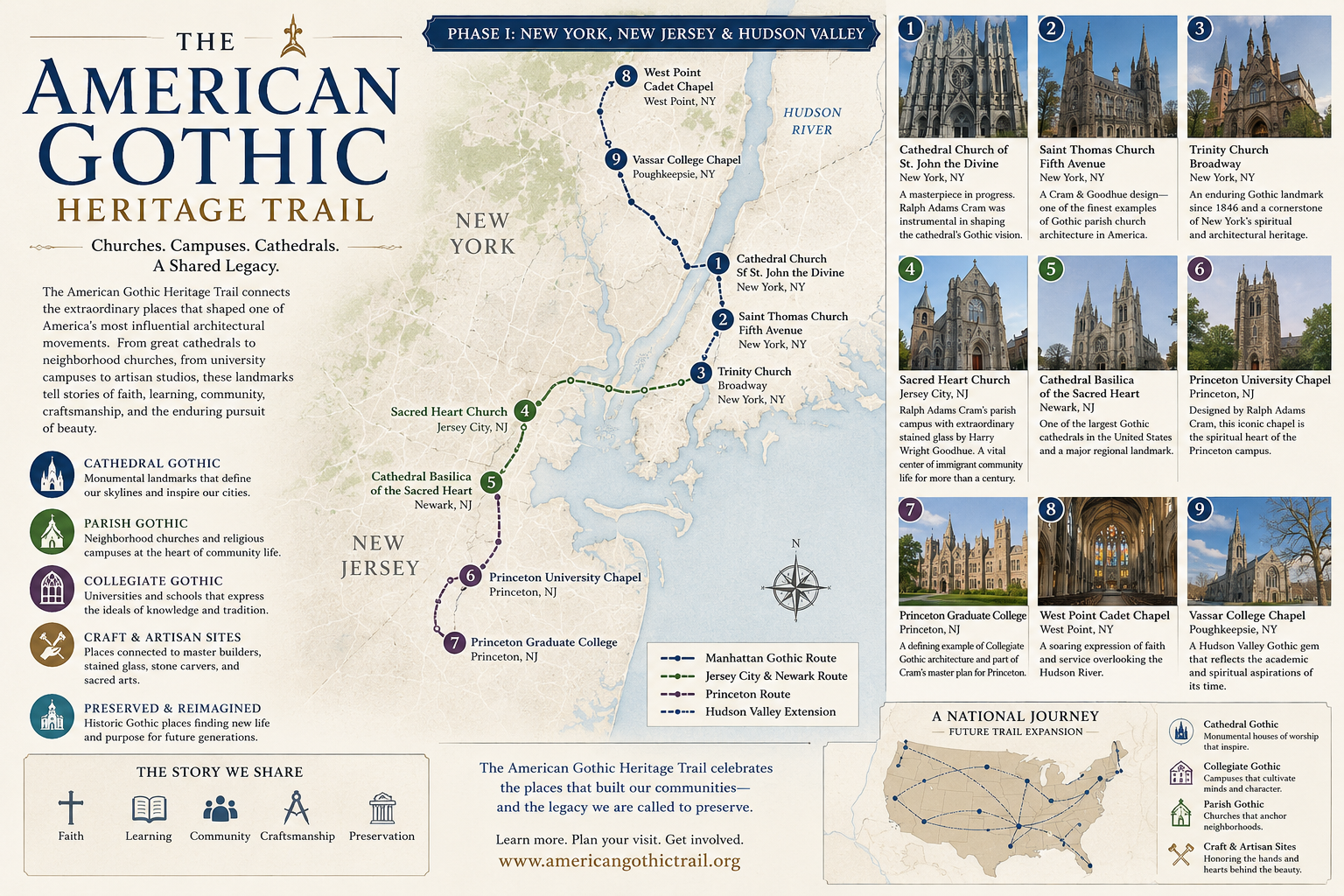
The American Gothic Heritage Trail connects significant Gothic Revival churches, cathedrals, chapels, and institutional landmarks across the United States—places that tell a national story about architecture, craftsmanship, faith, education, and civic ambition.
Sacred Heart rightfully belongs in that conversation and is a result of the hard work of the redeveloper, NJRA, City of Jersey City’s Planning Director, Historic Preservation Director and its staff. It is not simply an endangered building that survived. It is a major Gothic Revival campus being returned to use through adaptive reuse. That is precisely the kind of story the Trail should tell.
Preservation Requires Action
Sacred Heart's rebirth makes the point plainly: preservation is achieved through ownership, planning, approvals, financing, construction, and redevelopment. It requires people willing to take responsibility for buildings that others have spent years describing as important but not actually saving.
For decades, Sacred Heart was discussed as a building at risk. Now it is a building with a future the result of actual redevelopment, not rhetoric.
