Mother of Sorrows in Blue: Wright Goodhue, Rockefeller Chapel and the Stained Glass of Sacred Heart
In 1924, two members of the Goodhue family were deciding what stained glass should do inside a Gothic church. In Chicago, Bertram Goodhue chose pale, patterned light. In Jersey City, his eighteen-year-old nephew filled Sacred Heart with a wall of blue.
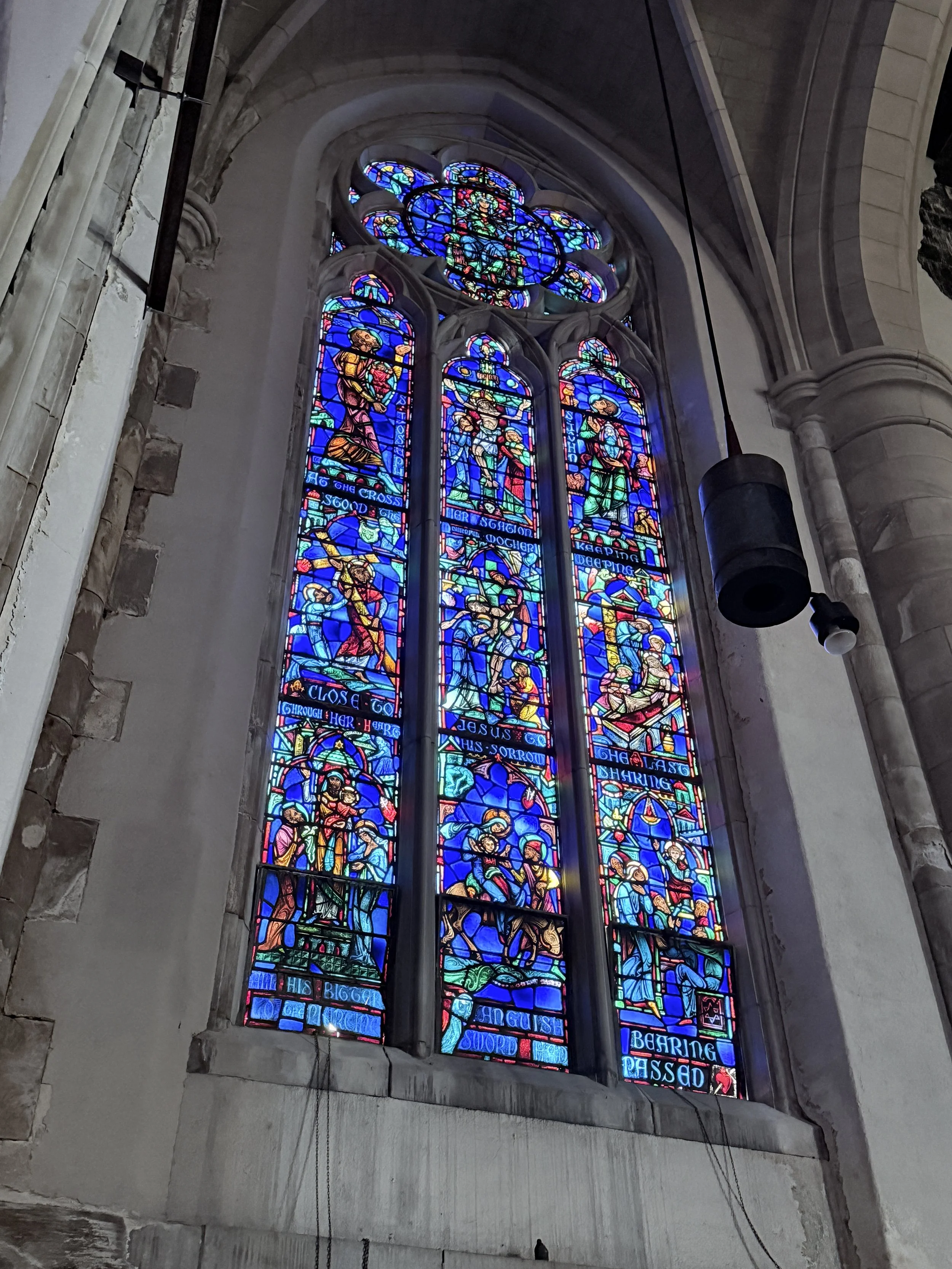
Wright Goodhue's “Seven Sorrows of the Virgin” stained glass at Sacred Heart of Jesus, Jersey City. Ralph Adams Cram designed the church, constructed between 1922 and 1924. The New Jersey State Library identifies Goodhue as the eighteen-year-old designer of its stained glass. Photo credit: Francisco Del Toro.
I began my career as a city planner for the City of Miami Beach, working on the redevelopment and adaptive reuse of historic twentieth-century buildings. As an architect and urban planner, I have spent years inside old buildings trying to understand what makes them worth keeping. Few have held my attention like Sacred Heart of Jesus in Jersey City.
I have spent a great deal of time inside Sacred Heart, and the windows still stop me every time I walk in.
They rise through Gothic stone tracery in fields of cobalt and ultramarine. Figures emerge in turquoise, ruby, amber and green, but blue dominates. It surrounds the figures, separates the scenes, fills the architectural backgrounds and climbs into the tracery until three individual lancets become one luminous composition.
Then comes the remarkable fact of who designed them.
Harry Wright Goodhue, generally known as Wright Goodhue, was a teenager. The New Jersey State Library identifies the stained glass at Sacred Heart as the work of the then eighteen-year-old Goodhue. Jersey City's historic resources survey likewise attributes the glass to him and identifies Ralph Adams Cram as architect of the church.
I understood these windows differently after I visited another building eight hundred miles away.
Born Into the Workshop
Wright Goodhue grew up inside one of the most important families in American Gothic Revival design.
His father, Harry Eldredge Goodhue, was an established Boston stained glass artist whose Cambridge studio trained a generation of designers, Wright among them. His father died in 1918, when Wright was thirteen.
His uncle was Bertram Grosvenor Goodhue, Ralph Adams Cram's former partner and one of the defining architects of the American Gothic Revival.
In 1921, Wright left school to work at the Boston architectural firm of Allen & Collens, first as an office boy and then as a draftsman. There he designed his first stained glass windows, including a chancel window for a church designed by his uncle. His later commissions included windows for churches by both Bertram Goodhue and Ralph Adams Cram.
He entered stained glass through both sides of that world: the workshop where glass was made, and the architecture that determined what it was for.
In 1924, he opened his own studio.
Two Goodhues, One Moment
From 1918 until his death in April 1924, Bertram Goodhue was designing Rockefeller Memorial Chapel at the University of Chicago, one of his final major commissions.
In the same months, his nephew was completing glass for Cram's church in Jersey City. Parish letters date this window to August 1924. That was four months after Bertram's death, and in the first year of Wright's independent studio.
The two buildings descend from the same partnership: Cram at Sacred Heart, Goodhue at Rockefeller. In the same years, two members of one family were designing glass for them. Both faced the same question: what should colored glass do inside a Gothic building of stone?
Having stood in both buildings, I can say they answered it in opposite ways.
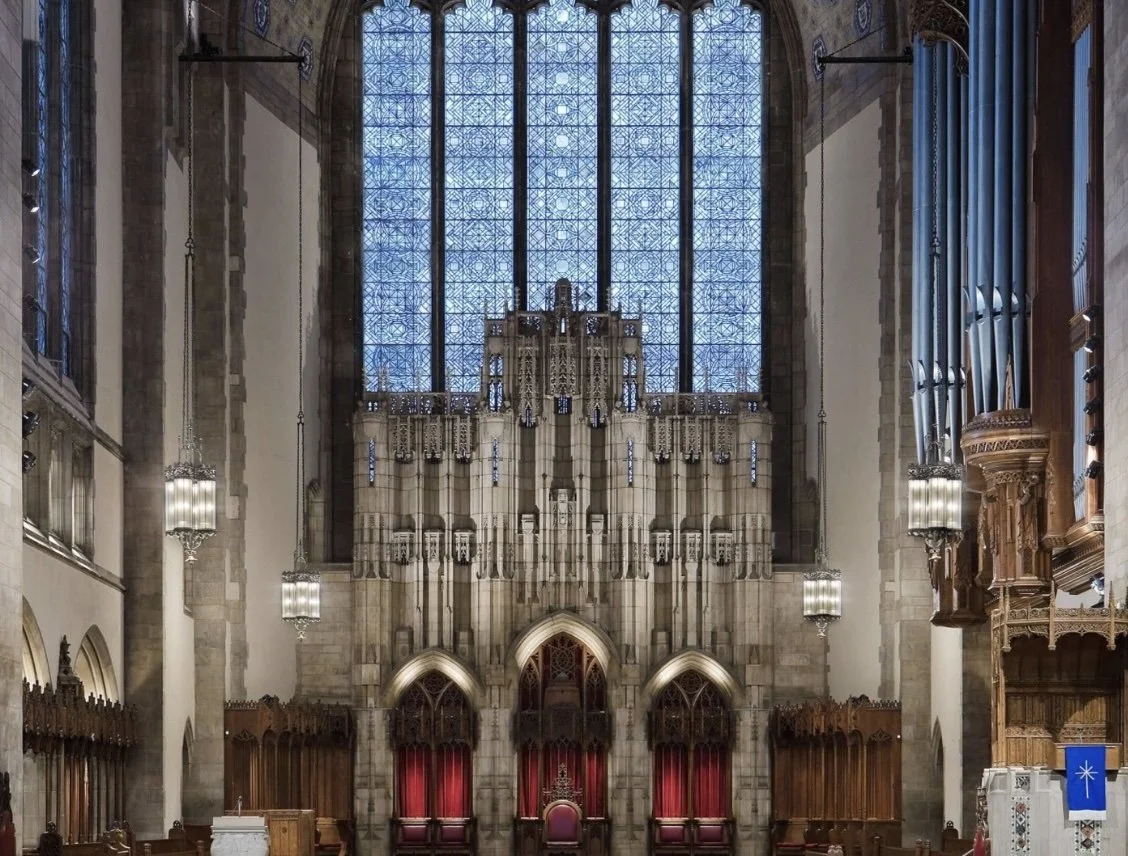
Rockefeller Memorial Chapel at the University of Chicago, designed by Bertram Grosvenor Goodhue between 1918 and 1924. The chapel was built between 1925 and 1928 and dedicated in 1928. Credit: Schuler Shook.
The University of Chicago describes Bertram Goodhue's glazing as employing soft greens, blues and mauves. More importantly, he deliberately chose patterned rather than pictorial windows. The purpose was to admit as much light as possible while minimizing competition with the architecture and sculpture.
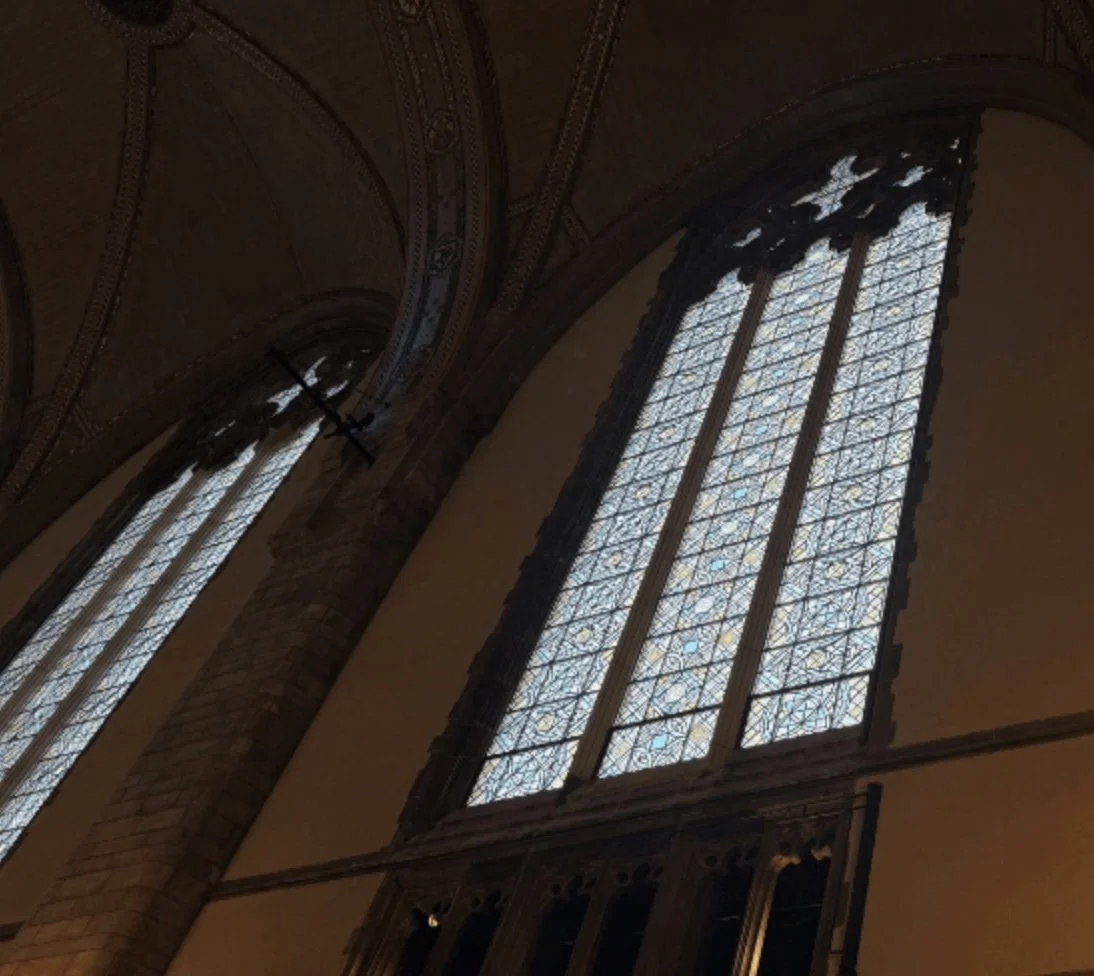
Detail of Rockefeller Memorial Chapel glazing. Bertram Goodhue's scheme used patterned glass in a restrained palette of soft greens, blues and mauves. Photo Credit: University of Chicago.
At Sacred Heart, Wright did nearly the reverse. His glass is saturated rather than pale, narrative rather than patterned, and commanding rather than deferential to the stone.
Two answers from one family. At Rockefeller, Bertram Goodhue conceived restrained, patterned glazing subordinate to the architecture. At Sacred Heart, Wright Goodhue filled Cram's Gothic openings with saturated color, figures, inscriptions and narrative.
The chronology rules out imitation in either direction. Wright could not have seen Rockefeller's windows before making Sacred Heart's, because the chapel was not built until 1925 to 1928. What connects the two buildings is simultaneity: the same family, the same tradition and the same years, producing two opposite ideas of what a Gothic window is for.
One Goodhue used glass to illuminate architecture.
The other used it to tell a story.
A Window About a Mother's Grief
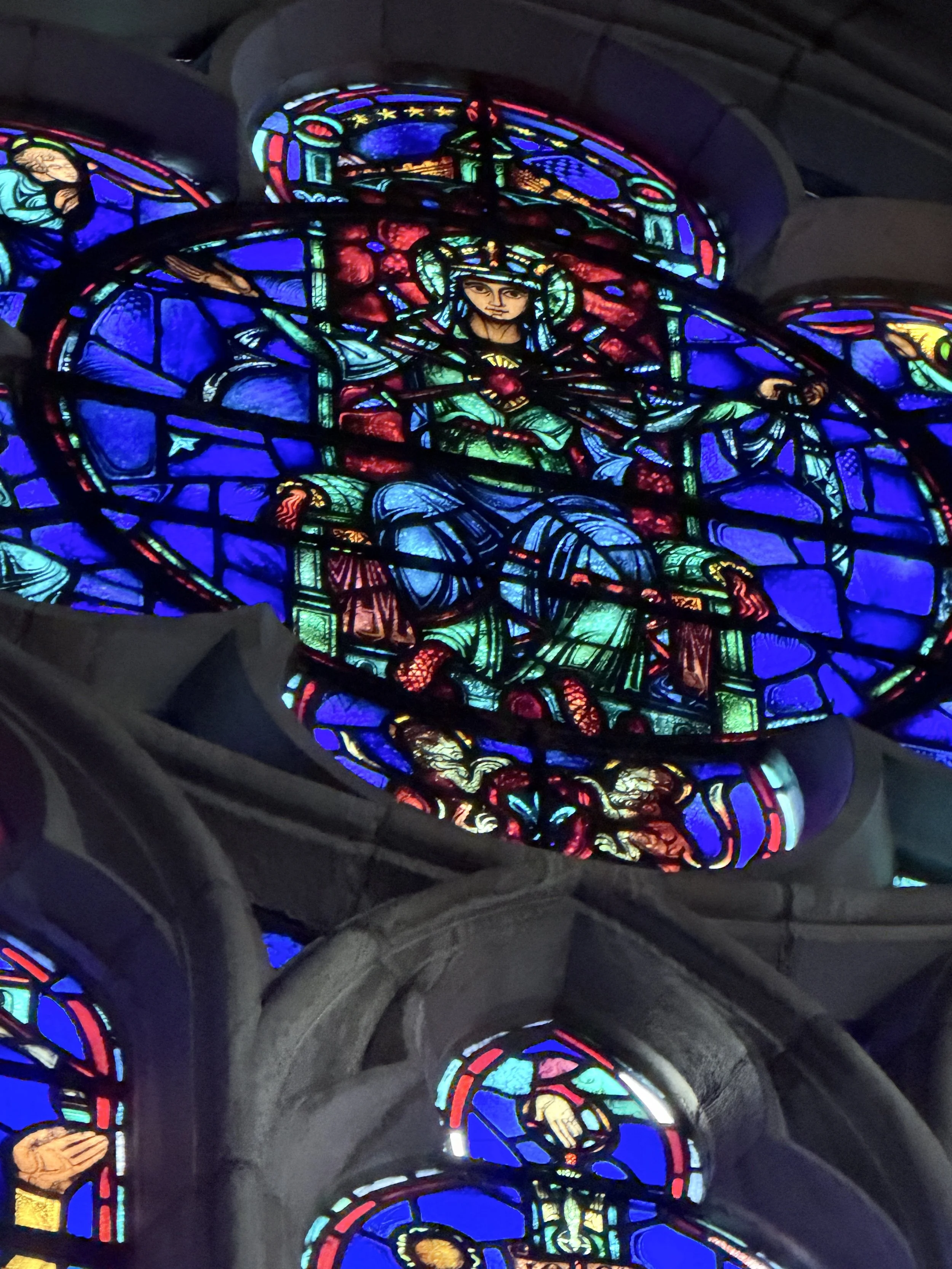
The rose above the three lancets. Mary sits enthroned and crowned, her heart pierced by swords, the emblem of Our Lady of Sorrows. Credit: Francisco Del Toro.
The story Wright chose to tell is written into the glass.
Across the three lancets runs the Stabat Mater, the medieval hymn contemplating Mary standing before the Crucifixion, in Edward Caswall's English translation:
At the Cross her station keeping,
Stood the mournful Mother weeping,
Close to Jesus to the last.
Through her heart, His sorrow sharing,
All His bitter anguish bearing,
Now at length the sword has passed.
The text is not incidental decoration. It is the key to reading the window.
The imagery is organized around the Seven Sorrows of the Virgin:
Simeon's prophecy
The Flight into Egypt
The loss and finding of Jesus in the Temple
Mary meeting Christ on the road to Calvary
The Crucifixion
The taking down of Christ's body
His burial
The hymn's final line completes the program. At the Presentation, Simeon warns Mary that a sword will pierce her soul. By the foot of the window, the sword has passed. In the rose above, her heart is pierced.
Wright reinforces the narrative with unusually explicit details. "Anna Prophetess" is lettered at the Presentation, and Veronica is named beside the scene on the road to Calvary.
This is exactly what Rockefeller's windows were designed not to do. Bertram Goodhue wanted glass that would not distract. His nephew built a window meant to be read.
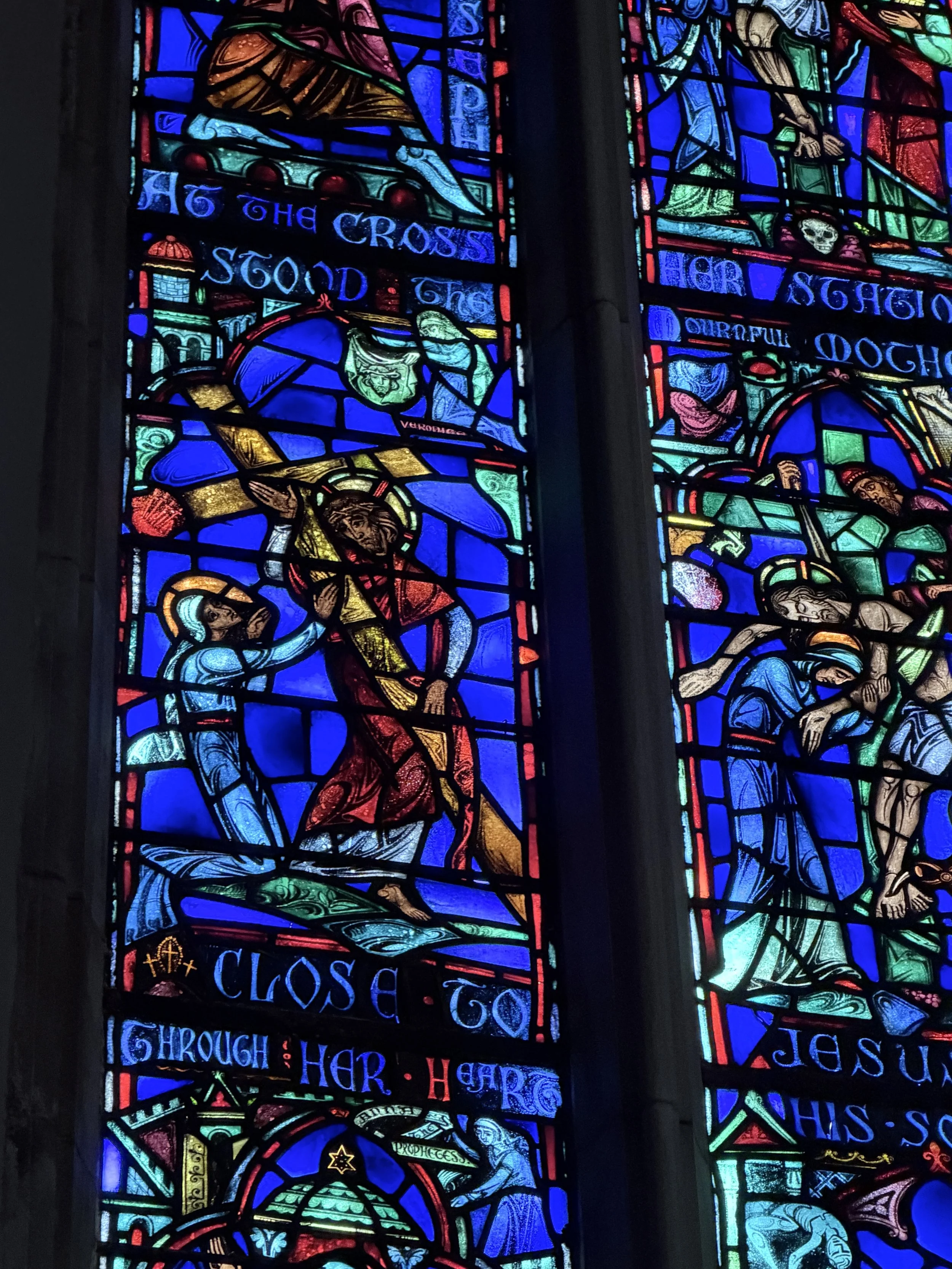
Mary encounters Christ on the road to Calvary. Veronica is identified in the glass above the scene. Goodhue concentrates red and gold around Christ against an overwhelmingly blue field. Credit: Francisco Del Toro.
Why So Much Blue?
Blue is where the two buildings share a color and part company.
Rockefeller's blues are soft, one pastel among greens and mauves. At Sacred Heart, blue is the ground of everything. In the scene of Christ carrying the Cross, his red and gold garments emerge against an almost uninterrupted blue field. In the Flight into Egypt, blue moves around and behind the figures. Elsewhere it surrounds architecture, bodies, inscriptions and ornament.
It does more than represent sky. Wright uses blue structurally.
Up close, the individual scenes remain distinct. From farther back in the nave, their boundaries begin to disappear. Blue moves from panel to panel and upward through the tracery, and seven separate episodes become one composition.
That suits the subject. The Stabat Mater gives Wright a continuous emotional narrative rather than seven unrelated illustrations, and the recurring blue binds the sorrows into a single window.
I know of no surviving statement from Goodhue explaining his palette. The reading here is my own, and it is visual.
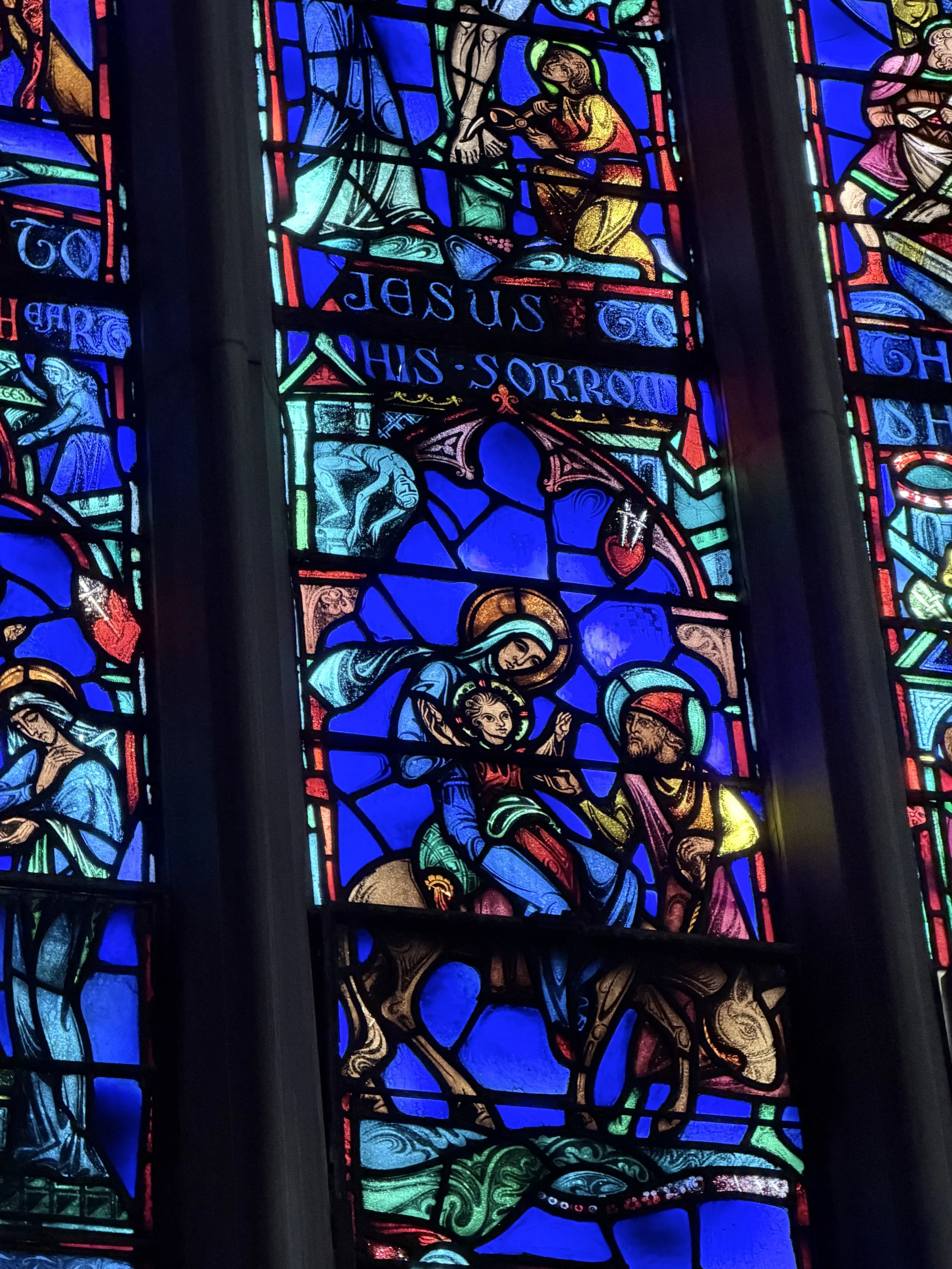
The Flight into Egypt. Blue runs across sky, background and surrounding decorative fields, connecting one episode of Mary's sorrow with the next. Credit: Francisco Del Toro
Seven Sorrows in One Window
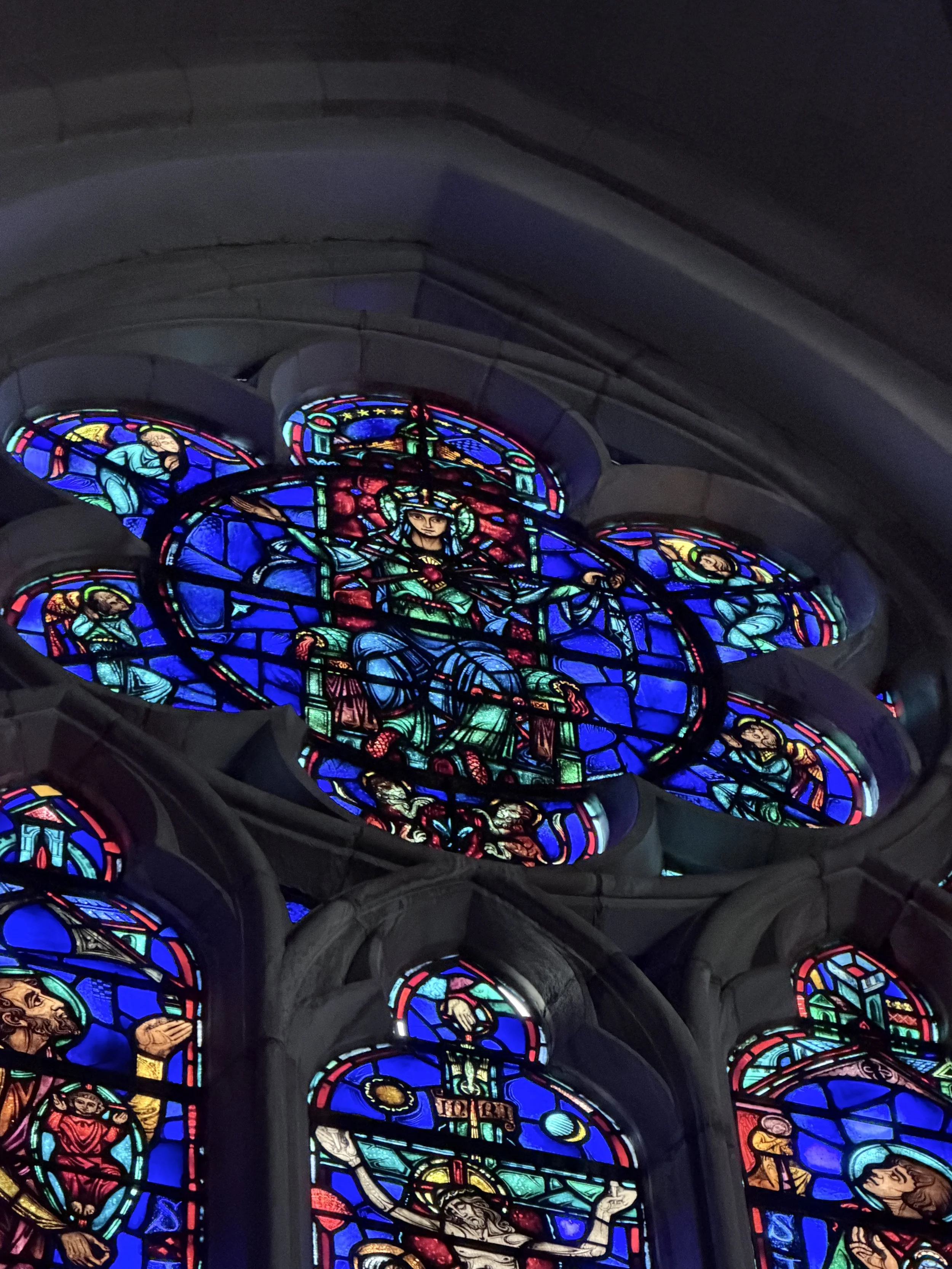
The upper portion of the Sacred Heart window. St. Joseph, the Crucifixion and St. John stand beneath the rose, where the Virgin sits enthroned. Credit: Francisco Del Toro.
The sorrows move across and up the three lancets, and above them all, Mary sits in the rose. The architectural tracery becomes part of the storytelling, crowning the narrative with the figure whose grief it describes.
This is where Wright's youth becomes hardest to reconcile with the finished work. He was not simply filling Cram's openings with attractive colored glass. He was coordinating architecture, text, iconography, narrative and color across a monumental composition, in a way his celebrated uncle had chosen not to.
The Glass Stays
A century after the window was installed, Sacred Heart of Jesus is entering a new life. The Vatican approved the adaptive reuse and rehabilitation of the former church as a performing arts and event space, first in 2020 and again in 2023. The sanctuary will no longer serve a religious use.
The glass stays.
The redevelopers are retaining the stained glass in its entirety. That includes Wright Goodhue's 1924 windows and every later campaign of glass installed in the church. The glass is among the elements identified for preservation, alongside the building's exterior form, its ironwork and its ceiling.
For someone who started out in Miami Beach working to give historic buildings new uses, this is familiar ground. A new program can keep a building alive, but only if it respects what made the building worth saving. At Sacred Heart, that begins with the glass.
The first step has been documentation. Every pane of glass in the sanctuary has been recorded with high-definition photography and LiDAR scanning, along with the church's marble, metalwork and wood carving. The result is a complete record of the windows as they exist today, made before any work begins.
The research has returned to primary sources:
The Cram & Ferguson Archive at the Boston Public Library
The Yellin Archives at the University of Pennsylvania
The chancery archives of the Archdiocese of Newark
The Seton Hall University archives
A private collection of documents recovered from safes and the storage crypt on the property, never previously made public
The building's significance has been on the record for decades. In 1995, the New Jersey Historic Preservation Office found the Sacred Heart Roman Catholic Church Complex individually eligible for the National Register of Historic Places under Criterion C. That finding drew on the professional evaluation in Jersey City's 1985 historic sites inventory. National Register listing is now being pursued.
The new use will change who sees the window, not what it says. Audiences will gather in the nave for performances and events beneath the same walls of blue light. The Stabat Mater will still run across the three lancets. The sword will still pass. Mary will still sit in the rose.
Wright Goodhue built a window meant to be read. It will now be read by a new audience.
A Voice Already Present
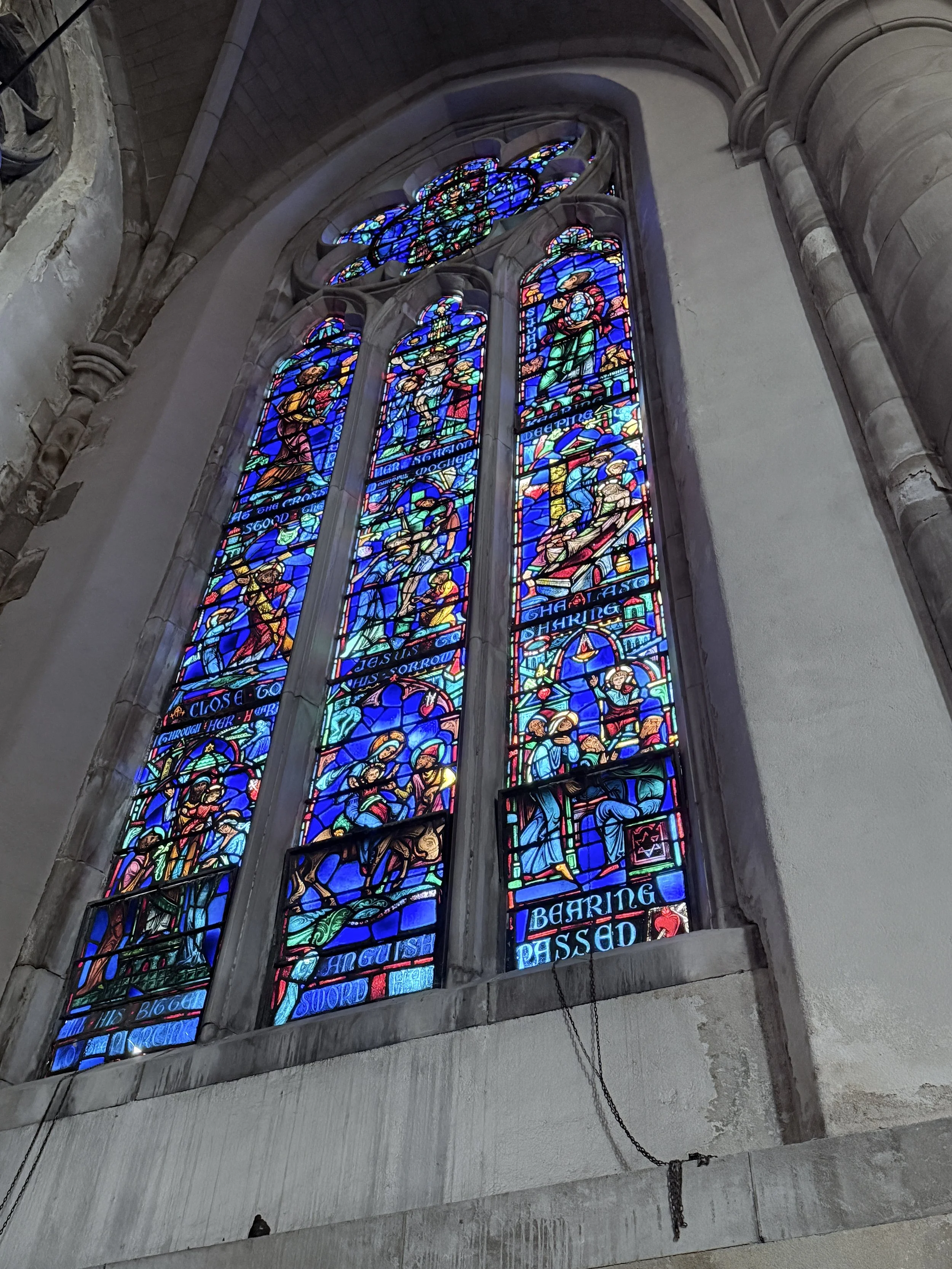
The Sorrows window at Sacred Heart of Jesus, Jersey City. Wright Goodhue's glass remains one of the defining elements of Ralph Adams Cram's interior. Credit: Francisco Del Toro.
Wright Goodhue's career would be extraordinarily short. He designed windows for more than thirty churches before his death in 1931, at only twenty-six.
Sacred Heart captures him at the start of his independent career, in the year his uncle's career ended. He inherited an extraordinary artistic world. His father gave him the craft of stained glass. His uncle belonged to one of the most consequential partnerships of the American Gothic Revival. Ralph Adams Cram gave him monumental architecture in which to work.
Inheritance alone does not explain this window. I have stood beneath Bertram Goodhue's quiet, patterned light in Chicago and beneath his nephew's blue in Jersey City. In the same year Bertram left Rockefeller Chapel its design, Wright took the Stabat Mater, a medieval hymn about a mother standing before the suffering and death of her son. He translated it into architecture, figures, words and light.
At Sacred Heart, an eighteen-year-old artist set a mother's grief in blue. A century later, it is staying there.
Sources: New Jersey State Library; Jersey City Phase 2 Historic Resources Survey; Sacred Heart parish letters; New Jersey Historic Preservation Office, letter of September 19, 1995 (HPO-I95-99); Cram & Ferguson Archive, Boston Public Library; University of Chicago, "Rockefeller Memorial Chapel restoration: Behind the scaffolding of UChicago's gothic masterpiece" (2026); SAH Archipedia, "Rockefeller Chapel"; Corning Museum of Glass, Rakow Research Library, Harry Wright Goodhue records; All Saints Parish, Brookline, "The Designers"; Stabat Mater, trans. Edward Caswall (1849).
About the Author: Frank Del Toro is an architect and urban planner. He began his career as a city planner for the City of Miami Beach, working on the redevelopment and adaptive reuse of historic twentieth-century buildings. He is a co-founder of Jaric Development, which the Archdiocese of Newark and the Vatican approved to redevelop the Sacred Heart religious campus in Jersey City.
